11 July, 2026
Saturday
AUSTRALIA
The Global Breakup with US Big Tech: Why Australian Businesses Need Sovereign Payments Now
A structural shift is occurring in the global economy. Across the European Union, Asia, and Latin America, governments and enterprise businesses are quietly executing a massive divorce. They are breaking up with United States-based technology conglomerates and reclaiming their "Digital Sovereignty."
For years, global cloud infrastructure and international payment networks were seen as harmless utilities. But as geopolitical tensions rise, countries are waking up to a chilling realization: relying on foreign-controlled tech infrastructure is a direct threat to national security, economic independence, and individual citizen privacy.
While Europe spends billions building local alternatives to shield itself, Australian businesses remain heavily dependent on US-based Point-of-Sale (POS) and payment systems.
Here is why global regulators are running away from US tech, how the United States legally exploits foreign data, and why Australian merchants must urgently transition to secure, sovereign local alternatives like HowToPay POS.
The European Precedent: Breaking the US Payment Monopoly
Europe is leading the global charge toward digital independence. For decades, the European payments market was entirely dominated by US financial giants like Visa, Mastercard, PayPal, Apple Pay, and Google Pay.
In response, a consortium of the largest European banks formed the European Payments Initiative (EPI) to build Wero—a sovereign, instant, account-to-account mobile payment system. Launched across Germany, France, and Belgium, Wero’s explicit, public mission is to bypass US payment rails entirely, lower transaction costs for local merchants, and keep European transaction data strictly under European jurisdictional control.
This movement is not limited to payments. It is occurring across the entire tech sector:
-
Sovereign Cloud Surge: According to leading technology analyst firm Gartner, worldwide spending on sovereign clouds is projected to hit $80 billion, driven heavily by European enterprises and public sector agencies redirecting their workloads away from US hyperscalers (Amazon Web Services, Microsoft Azure, and Google Cloud) and toward localized, sovereign alternatives.
-
The EU Data Act: Legally enforced regulations now mandate that cloud providers operating in Europe must support seamless service switching and actively block foreign government agencies from accessing EU-stored data.
-
The Regulatory Crackdown: Data protection authorities in Austria, France, Germany, and Italy have repeatedly ruled that transferring consumer data to US-controlled systems violates strict local privacy frameworks (such as GDPR).
Europe has realized that digital sovereignty is not just about where your servers are physically located—it is about who holds the keys to the kingdom.
The US CLOUD Act: Why Overseas Servers are Built to Spy
Many business owners believe that if a foreign software giant (like Square, Shopify, or Lightspeed) uses a local Australian database node, their data is safe.
This is a dangerous technical and legal misunderstanding.
In March 2018, the United States enacted the Clarifying Lawful Overseas Use of Data (CLOUD) Act. This legislation has extraterritorial reach. It legally compels any company headquartered in the US—or subject to US jurisdiction—to hand over data to US law enforcement and government agencies upon warrant, regardless of where that data is physically stored in the world.
If you use an American POS system, and that system holds your Australian customer data in a database in Sydney, the US government can legally force that company to copy those records and transmit them to Washington.
Even worse, the US legal system does not protect foreign citizens:
-
Zero Constitutional Rights for Australians: The United States Constitution (specifically the Fourth Amendment, which protects against unreasonable search and seizure) does not apply to non-US citizens located outside American borders.
-
Unchecked Foreign Surveillance: While US law enforcement requires strict judicial warrants to look at a US citizen’s data, foreign consumer transaction records, marketing profiles, and operational business details can be swept up and accessed under broad, foreign national security directives without your knowledge, consent, or any right to appeal.
-
Jurisdictional Subservience: Because US companies are bound by their home country's laws, they face an irreconcilable conflict of interest. When forced to choose between protecting an Australian small business’s customer list or complying with a US federal subpoena, they will comply with the US government every single time.
Why POS and Payment Sovereign Control is Critical National Infrastructure
Think about the sheer volume of data your POS system processes every day. It tracks what your customers buy, how much they spend, when they visit, their phone numbers, and their email addresses.
When hundreds of thousands of local cafés, boutique retailers, and restaurants use foreign-controlled POS systems, a massive amount of intelligence on the Australian population is constantly being exported overseas.
When every flat white, retail purchase, and loyalty sign-up pays a transaction clip to Silicon Valley and records consumer habits in a database subject to foreign surveillance, Australia loses its financial and digital independence. It leaves our local economy highly vulnerable to:
-
Foreign Intelligence Harvesting: Aggregated transaction metadata can be analyzed by foreign algorithms to build deep economic profiles on domestic spending habits, supply chain vulnerabilities, and consumer behavior.
-
Arbitrary Fee Hikes: Foreign conglomerates answer to global shareholders, not local communities. They can—and routinely do—arbitrarily raise merchant SaaS fees and payment margins, leaving margin-squeezed Australian hospitality and retail venues with no recourse.
-
Systemic Operational Risks: Relying on centralized, global public clouds means that a single global routing failure or underwater cable issue can take down local registers, paralyzing your checkout lines.
The Sovereign Shield: Transitioning to HowToPay POS
Australian business owners do not have to accept the vulnerability of foreign tech dominance.
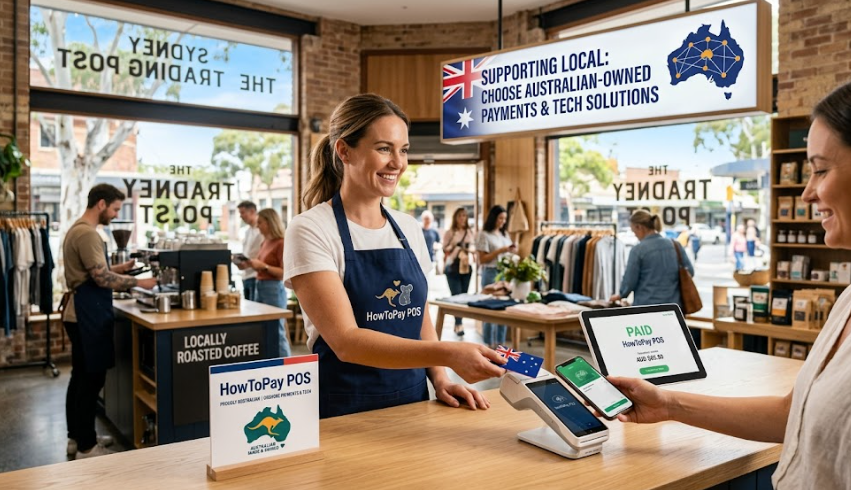
HowToPay POS was built to provide a 100% secure, sovereign alternative designed strictly for the unique regulatory and economic realities of Australian merchants.
-
100% Australian Owned and Managed: Every cent of transaction fee profit stays within the local economy, supporting local jobs and domestic innovation instead of being outsourced to multinational corporate giants.
-
Proprietary, Isolated Local Hosting: Your customers' data never crosses international borders. It is stored safely onshore within secure, isolated Australian data centers, keeping your business completely clear of Section 16C cross-border liabilities and foreign surveillance laws like the US CLOUD Act.
-
The Margin-Saving PayID Engine: Rather than relying on credit card processing commissions controlled by foreign banking schemes, HowToPay POS features native, instant PayID integrations. This allows your customers to pay directly and securely from their local Australian bank accounts—giving you a seamless pathway to bypass card processing fees ahead of the upcoming October 1, 2026 card surcharging ban.
-
Zero-Friction AI Menu Migration: Making the switch is simple. With HowToPay’s AI-Driven Data Import Engine, you don’t have to manually rebuild your menus, input complex tax rules, or transfer historical ledgers. Simply upload a CSV or photo of your menu, and our AI constructs your POS profile instantly, free of charge.
Protect your business, preserve your customers' privacy, and support Australian economic independence. Contact the team at HowToPay POS today to claim your free data compliance audit and see how easily our AI migration engine can transition your business to a safe, sovereign local network.
References & Official Frameworks
To verify the global shift toward digital sovereignty, the extraterritorial reach of US data laws, and the local alternatives detailed in this post, consult the primary sources below:
-
The US CLOUD Act & Extraterritorial Jurisdiction:
Read the official legislative resources and bilateral agreements explaining how the US government exercises reach over global tech platforms at the US Department of Justice - CLOUD Act Resources.
-
The Rise of Sovereign Cloud Spending ($80 Billion Projections):
Review the analytical reports tracking the massive global movement of enterprises diverting workloads away from US hyperscalers to regional, sovereign alternatives at Asee.io - Why Businesses Are Moving Away from US Cloud Providers.
-
European Sovereign Payments & The Wero Launch:
Learn about the European Payments Initiative's official launch of Wero to establish payment independence from US systems at Wero (Payment) - Wikipedia Overview and track its 2025/2026 commercial expansion plans at Banking.Vision - Wero Payment Engine Accelerates.
-
The Conflict Between Foreign Surveillance and Domestic Privacy:
Review the legal boundaries and the lack of privacy protections afforded to non-US citizens under foreign surveillance laws at the Business Software Alliance - The CLOUD Act and the EU: Myths vs. Facts.