16 July, 2026
Thursday
POS

The Hidden Risk of “Free” POS Software Bundled With Hardware
When businesses invest in new point-of-sale (POS) systems, the focus is often on the hardware. Sleek touchscreens, compact terminals, modern designs, and competitive pricing all make today’s POS hardware offerings look appealing. However, what many business owners fail to realise is that the real risk does not lie in the hardware itself — it lies in the software bundled with it.
In many cases, the POS software included “for free” with hardware is an afterthought. It is basic, infrequently updated, poorly supported, and often unsuitable for real-world business operations once the initial setup phase is over.
Flashy Hardware, Weak Software Foundations
POS hardware is frequently sold by vendors whose core expertise is manufacturing or distributing devices — not building robust business software. As a result, the bundled POS software is often designed only to meet minimal requirements: taking payments, printing receipts, and processing basic transactions.
What this software usually lacks is far more important:
-
Regular updates and feature improvements
-
Compliance with regional tax, revenue department, and reporting requirements
-
Integration with accounting platforms and external systems
-
Scalable data import and export capabilities
-
Advanced reporting and business intelligence
-
Support for modern workflows across multiple locations or countries
Over time, businesses discover that while the hardware still works perfectly, the software becomes a bottleneck that restricts growth, visibility, and compliance.
Little to No Ongoing Development
One of the most common issues with bundled POS software is stagnation. Updates are rare, if they occur at all. Regulatory requirements change. Payment methods evolve. Customer expectations shift. Yet the software remains frozen in time.
This creates real operational risk. Businesses may find themselves manually working around system limitations, exporting data in incompatible formats for their accountants, or struggling to meet tax and reporting obligations due to inflexible software design.
In contrast, modern POS software should be treated as a living system — continuously improved, adapted, and refined.
The Missing AI and Data Connectivity Problem
Another major gap in bundled POS software is the absence of AI and modern data connectivity. Very few hardware-bundled POS systems offer:
-
AI-assisted product setup or descriptions
-
Intelligent reporting and insights
-
Integration with AI marketplaces or automation tools
-
Clean, accountant-friendly data exports
-
APIs for connecting to third-party platforms
For many businesses, this becomes painfully clear when their accountant cannot easily use POS data, or when management wants deeper insight into sales trends, inventory behaviour, or customer activity.
Support Ends After the Sale
Support is another critical weakness. While hardware vendors may assist during the initial sale and setup, ongoing support for the bundled software is often limited, slow, or non-existent.
When issues arise — failed updates, data inconsistencies, reporting errors, or system limitations — businesses are frequently left without meaningful assistance. The “free” software quickly becomes expensive in terms of lost time, inefficiency, and operational frustration.
Why Software Choice Matters More Than Hardware
The reality is simple: POS hardware is largely interchangeable. POS software is not.
A well-chosen software platform can run on existing hardware, extend its lifespan, and dramatically improve business operations. A poor software choice can force premature hardware replacement, complex workarounds, or full system migrations.
This is where HowToPay POS is fundamentally different.
HowToPay POS: Designed for Real-World Business Needs
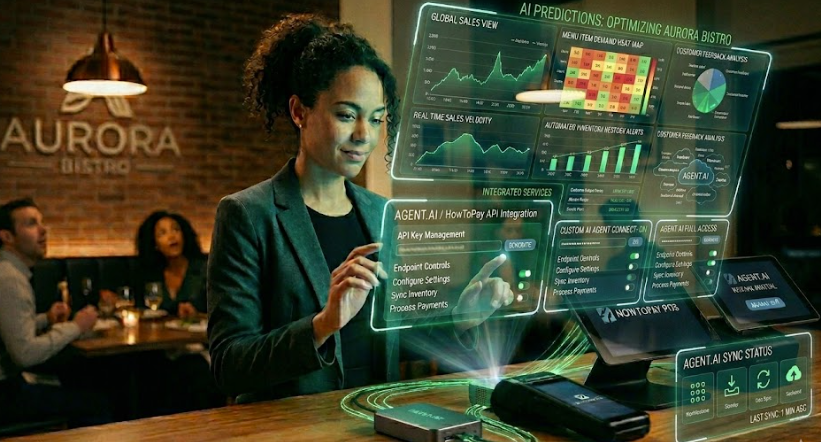
HowToPay POS was built with software — not hardware — as the priority. It is a modern, cloud-based POS system designed to work across existing devices and evolve alongside businesses.
Key differentiators include:
-
Weekly updates and continuous improvement
-
Support for Android, Windows, and macOS (OS X)
-
Easy deployment on existing POS hardware
-
Regional adaptability for tax and reporting requirements
-
Modern data import and export suitable for accountants and finance teams
-
AI-ready architecture with growing AI integrations
-
Professional support focused on long-term success, not just installation
For many businesses, the core pain point is not buying new hardware — it is finding better software to run on the hardware they already own. HowToPay POS specialises in exactly this challenge.
A Warning to POS Hardware Buyers
Before purchasing POS hardware, business owners should ask a critical question:
Is the bundled software truly fit for my business — today and in the future?
If the answer is unclear, the risk is high.
The software included with POS hardware is often basic, poorly supported, and rarely improved. While it may function initially, it can quickly limit growth, compliance, and operational efficiency.
Choosing an independent, actively developed POS platform like HowToPay POS allows businesses to protect their hardware investment, gain modern functionality, and future-proof their operations — without being locked into outdated, underdeveloped software.
In the POS world, software is not a bonus feature. It is the foundation.
Source: howtopay.com
Tags: